
- News Center
Event news
AALD News
AALD News
AALD Visits Guangdong Baiyun University to Discuss Design Education in the AIGC Era
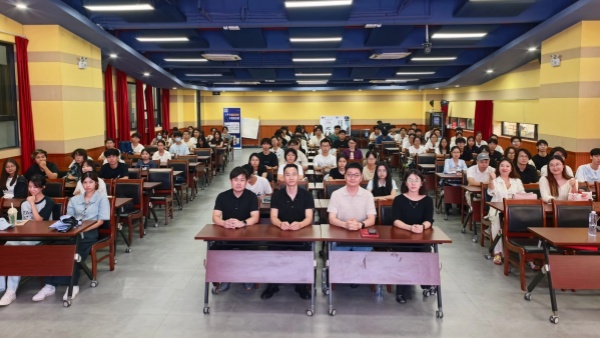
On October 15, the School of Architectural Engineering of Guangdong Baiyun University, in collaboration with the Asian Association of Lighting Designers (AALD) and the Zhongzhao Jinzhi A-Station Platform, hosted an AIGC-themed lecture, alongside an expert appointment ceremony for the Intelligent Environment Laboratory.
Teacher Feng Xiaoyang from Guangdong Baiyun University opened the event by introducing the guests. Referencing the university’s "Major + AI" teaching reform, he reminded students not to cling to outdated mindsets, to make good use of university-enterprise resources, and integrate their professional competencies with AI. During the ceremony, Feng Xiaoyang and Hu Shunhua, Chief Engineer of New Landscape R&D Center, jointly presented the expert appointment certificate of the Intelligent Environment Laboratory to Ma Bin, Secretary-General of AALD and Founder of Zhongzhao Jinzhi.
In the keynote session, Ma Bin delivered a speech titled *Past · Present · Future: The Vision of AIGC*. Regarding talent cultivation, he introduced the **A-Station Future Design Talent Scholarship Program**. Following South China University of Technology, Guangdong Baiyun University has now joined this initiative. Built upon the A-Station AIGC digital design platform, the program offers AIGC workflows, computing resources and industrial practice opportunities, empowering students to shift from merely operating software to solving real-world design challenges.
In the subsequent sharing, Chen Huijun, Optical Intelligence Architect at Zhongzhao Jinzhi, focused on practical professional application scenarios. Taking lighting and luminous environment design as examples, she demonstrated how the A-Station AI platform supports concept development, creative iteration and result presentation. She emphasized that learning AI is not equivalent to simply mastering software; it needs to align with complete professional business workflows.
During the Q&A session, drawing on corporate design practices, Hu Shunhua pointed out that although AI has lowered the technical barriers for certain operations, it cannot replace professional knowledge and design experience. Students should not only learn to use AI, but also be capable of evaluating its outputs, and translate technical skills into the ability to tackle practical design problems.
This event marks a key practice of university-enterprise collaborative education carried out by the Intelligent Environment Laboratory. Moving forward, the School will continue to cooperate with AALD and the A-Station Platform to integrate new technologies and industrial projects into teaching, cultivating application-oriented design talents equipped with professional judgment, technical proficiency and problem-solving capabilities.